Homepage
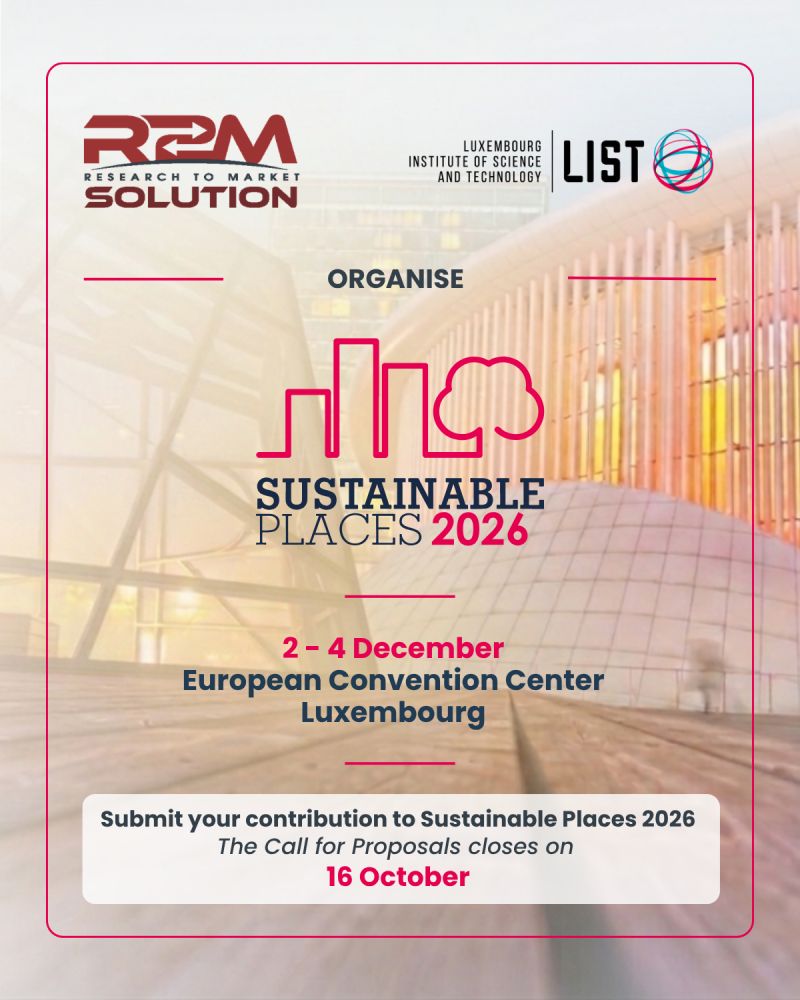
SUSTAINABLE PLACES 2026
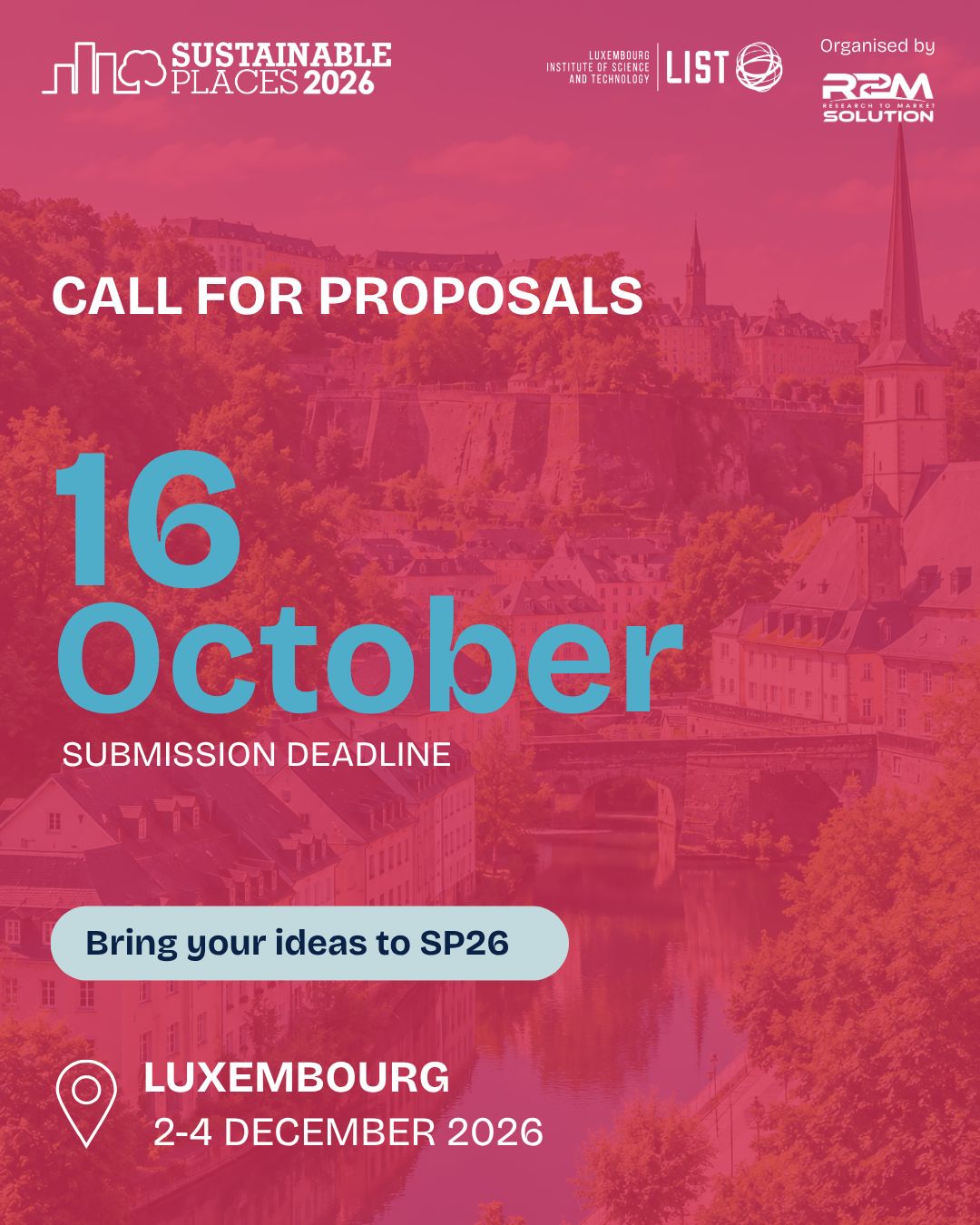
The Luxembourg Institute of Science and Technology (LIST) and R2M Solution are delighted to welcome you back to Luxembourg in 2026!
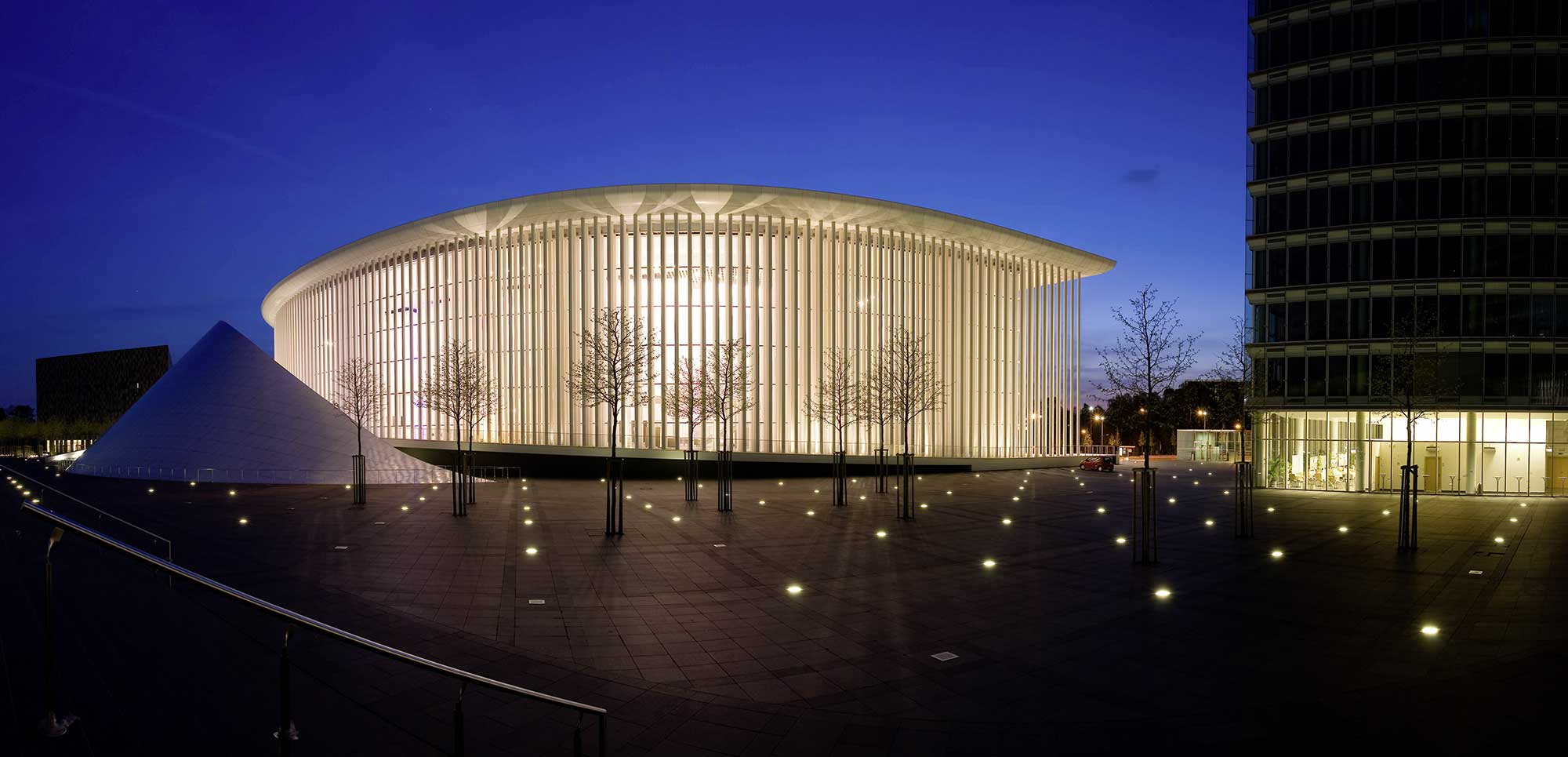
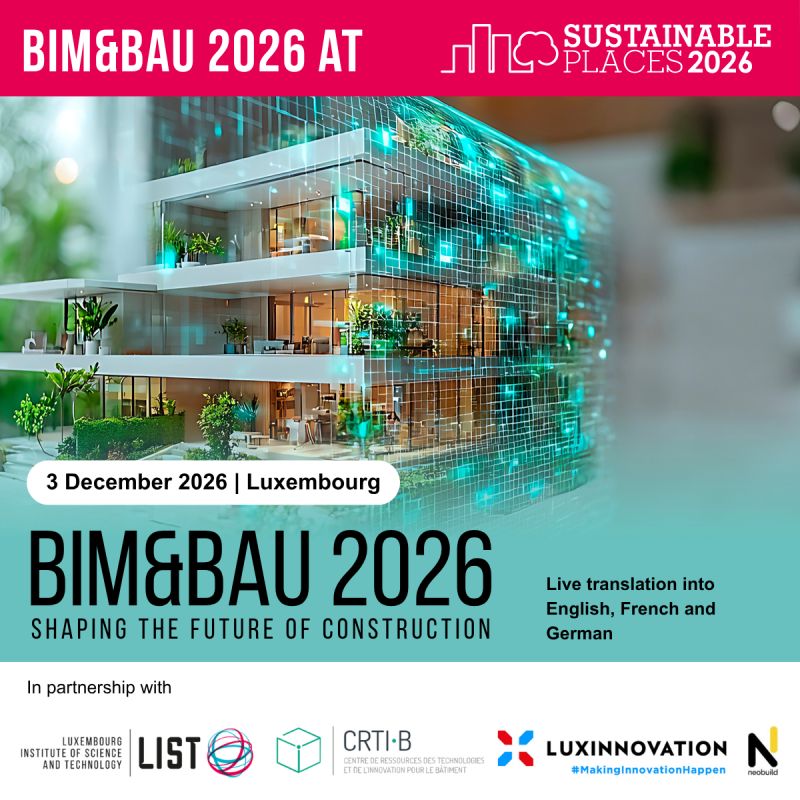
We look forward to seeing you at the European Convention Center Luxembourg for the first-ever winter edition of Sustainable Places.
Do you already have a workshop to organize, want to synchronize your project’s final event with the conference, or co-design a thematic track? Contact the organizing committee now to secure the best spot in the agenda.
Relive the energy of Sustainable Places 2025 in Milan through the videos below, showcasing the inspiring discussions, innovative projects, and vibrant networking that made the event unforgettable.
They offer a glimpse of what’s in store for 2026 in Luxembourg!
SP scope
Sustainability targets and climate change objectives cannot be met without addressing buildings and the built environment at the building, district and urban scale to include our transport and energy infrastructures. Renowned for showcasing results coming out of the EU Horizon 2020 and EU Horizon Europe Framework Programmes via the participation of cutting-edge research and innovation projects, the scope of SP is captured directly in its name. It involves designing, building and retrofitting the places we live and work in a more sustainable way.
SP concept
SP prides itself on being an ideal platform for the dissemination of research, the conduct of workshops, EU project clustering and networking between stakeholders of all types. SP25 was held over three days in a hybrid (digital + in-person) event format. Between opening and closing keynote sessions, parallel technical sessions and project-organized workshops explored the various conference themes. Given world events we encouraged submissions on technology transfer, renewable energy implementations and energy security with the aim of facilitating actions that increase the rate of renovation and renewable energy implementations.
SP26 SCIENTIFIC COMMITTEE
is senior research engineer at LIST (Luxembourg Institute of Science and Technology), where she has been working since 2009. She graduated in Architecture from the Victor Horta Institute (Brussels, 2001), completed an MSc in “Modelling and Simulation of Built Spaces” at the École d’Architecture de Nancy (France, 2002), and obtained her PhD in Architecture Science at the INPL (Nancy, France, 2009). Her research focuses on BIM, digital twins, collaborative processes in construction, circular economy, smart buildings and districts, and post-occupancy evaluation, contributing to numerous projects, publications, and technological prototypes.
is Research Group Leader for the Sustainable Urban and Built Environment (SUBE) Group at LIST (Luxembourg Institute of Science and Technology), where he has been working since 2007. He studied Architecture in France and Switzerland and graduated from the Architecture School of Nancy in 2003, before completing a MSc and PhD in Computer Science at the University of Lorraine (2003, 2006). His research focuses on BIM, digital twins, 3D modelling, simulation, and the digitalisation of the construction sector, contributing to software development, consultancy, and applied innovation projects.
Dr. Alain Zarli is senior Managing Partner at R2M Solution and served as Secretary General of the European Construction Technology Platform (ECTP). He was previously Head of the “Innovation Numérique pour la Construction” division and European Affairs Manager at CSTB, France. His expertise spans ICT for the built environment, including BIM, Digital Twins, semantic modelling, and smart construction technologies. He has coordinated numerous European FP5–Horizon Europe projects, contributed to ECTP initiatives and the Built4People Partnership, and served as expert for the European Commission on R&D, smart cities, and sustainable districts.
Professor Yacine Rezgui specialises in performance management in the built environment, focusing on buildings and infrastructures in energy efficiency, Life Cycle Sustainability Assessment, and circularity. He has authored over 300 refereed publications, including in Proceedings of the Royal Society A and IEEE Transactions journals. He is co-founder of the university spinout Optimise-AI, which serves clients such as Network Rail, ScotRail, and Luton Airport, applying AI-driven solutions to optimise the sustainability and performance of the built environment.
Professor Diego Reforgiato Recupero has been Full Professor at the Department of Mathematics and Computer Science, University of Cagliari, since 2022. He holds a double bachelor in Computer Science from the University of Catania and a PhD from the University of Naples Federico II. He co-founded several companies, including SentiMetrix (US), R2M Solution (Italy/UK), La Zenia, B-UP, and VISIOSCIENTIAE, and is co-inventor of a patent in data mining and sentiment analysis. His research spans semantic web, AI, and ICT for smart and sustainable systems.
Dr. Mia Ala Juusela, D.Sc. (Tech), is Senior Scientist at VTT with 25 years of research experience in eco-efficient communities. Her expertise covers energy-efficient buildings, renewable energy integration, and optimising energy demand and supply at building and district scales, with a strong focus on user perspectives and human thermal comfort. She has coordinated EU projects including EXCESS, STORY, and IntUBE, and contributes to the Built4People initiative on people-centric innovation. She also teaches a course on solar energy at Oulu University of Applied Sciences.
Professor Tracey Crosbie is Professor of Sustainability in the Built Environment at Teesside University. A transdisciplinary academic with degrees in social and technical sciences, she has over 20 years of experience in interdisciplinary research on energy and sustainability in urban environments. She has led projects with more than 80 partners, including VTT, SINTEF, Fraunhofer, Siemens, and IBM, and is visiting Professor at LPU, India. Her research spans urban studies, ICT, civil and electrical engineering, and social policy, and she has been involved with the Sustainable Places International Conference since 2013.
Professor Evina Katsou is Chair Professor in Water Engineering at Imperial College London and leads the 32-member Resilience and Sustainability Group. She is an internationally recognised expert in water resilience, circular economy, and environmental systems engineering. She has coordinated over 45 European and national research projects, acting as Principal Investigator in 36, and develops AI-driven decision-support systems, circularity metrics, and sustainability platforms. Prof. Katsou also contributes to IPCC assessments, European water policy, ISO standards, and ICT4Water initiatives, and has authored over 130 publications, 14 book chapters, and 250+ conference presentations.
Dr. Vasileia Vasilaki is a Research Associate at Imperial College London with expertise in digitalisation and sustainability science, focusing on AI-based water and environmental solutions. Her research develops AI-driven methodologies, models, and decision-support tools to support circularity, resilient environments, and net-zero transitions across water, energy, and industrial systems. She has contributed to numerous European and national projects, published 19 peer-reviewed articles, co-leads Working Group 3 in COST Action CA21146, and is active in specialised research groups on intelligent and sustainable cities.
Dr. Antonis Vlasopoulos is a Research Fellow at Brunel University London and Research Associate at Imperial College London, and founder of Synthete, a consulting firm in research and innovation strategy. He has over 13 years of experience in EU-funded collaborative projects, supporting more than 300 proposals and securing multi-million-euro grants. His research focuses on industrial production, energy systems, sustainability, and digital technologies, including life cycle assessment of sustainable industrial solutions. He holds a PhD in Mechanical and Aerospace Engineering from Brunel University and a Diploma in Chemical Engineering.
Professor Paris Fokaides has over 20 years of experience in sustainable energy research, with a focus on biomass and waste-to-energy technologies. He is Senior Researcher at the Sustainable Energy Research Group (SERG), leading European research projects and collaborations with academic and industrial partners, and Professor at Frederick University, Cyprus. He holds a PhD in Sustainable Energy from Karlsruhe University and a Diploma in Mechanical Engineering from Aristotle University. His work spans sustainable built environments, bioenergy processes, and renewable energy integration, with over 80 journal publications, 10 book chapters, and several awards and patents.
Professor Henk Visscher is Professor of Housing Quality and Process Innovation at the Faculty of Architecture and the Built Environment, TU Delft, within the Management in the Built Environment department. He is also Director of the TU Delft Urban Energy Institute. His research and teaching focus on the physical quality of new and existing housing, and on the policies and processes required to improve and safeguard this quality. His work addresses energy performance, sustainability, safety, health, accessibility, and functionality in residential buildings.
Professor Raphaël Frank is Professor and Chief Scientist at the Interdisciplinary Centre for Security, Reliability and Trust (SnT), University of Luxembourg, where he heads the UBIX Research Group in artificial intelligence. He is Director of the IPBG ATLAS Industrial PhD Programme and Adjunct Professor at HEC Liège Luxembourg. He received his PhD in Computer Science from the University of Luxembourg in 2010 and was a visiting scholar at UCLA. His research focuses on AI applications across multiple domains. In 2014, he co-founded Motion-S Telematics, a university spin-off providing telematics solutions for usage-based insurance and fleet management.
Professor Maria Pia Fanti is Full Professor of Control Systems Engineering at the Polytechnic University of Bari and Chair of the Laboratory of Automation and Control. An IEEE Fellow, she received her Laurea degree in Electronic Engineering from the University of Pisa and has been with the Polytechnic of Bari since 1983. Her research focuses on modelling and management of complex systems, including intelligent transportation, logistics and manufacturing systems, discrete event systems, Petri nets, fault detection, and cybersecurity. She has authored over 370 publications and two textbooks, and serves in leading editorial and governance roles within the IEEE Systems, Man, and Cybernetics and Robotics and Automation communities.
Professor Lizhen Huang is a Professor of Civil Engineering and Geomatics and leads the Civil Engineering and Geomatics Group at the Department of Manufacturing and Civil Engineering. She also leads strategic research on digital twins for sustainable built environments and has served as Innovation Leader at faculty level, promoting research–innovation–education integration. Over the past decade, she has authored more than 50 high-impact journal publications, including highly cited work informing international policy. She has secured over €5 million in research funding, supervises doctoral and postdoctoral researchers, and actively contributes to European innovation platforms and scientific evaluations.
SP26 themes
Each year, Sustainable Places features topics that are shaping how we think about cities and the built environment. Across all editions, Sustainable Places is open to all topics related to building sustainability and most often reflect priorities described in the European Commission Societal Challenges and the United Nations Sustainable Development Goals.
For SP26, we proposed the list of themes shown below.
These themes were non-exhaustive and proposals received on other topics related to sustainability were considered for acceptance.
Energy communities, smart cities & urban transition
Sustainable construction & renovation
Climate change mitigation & adaptation
Facilitating the energy transition: policy, finance, training
Sustainable urban renewal & cultural transformation
Renewable energy technologies
Decarbonisation & circularity
Resilience & energy security
Data centres, digital twins & artificial intelligence for sustainability
Sponsorship opportunities
We again welcomed and invited sponsorship at SP26.
For organizations looking to increase brand exposure and visibility to Europe’s top R&D performers, sponsorship offer an excellent mechanism to do that. Sponsors can enjoy excellent visibility, assistance with networking, the opportunity to exhibit and the opportunity to co-create moments that met their specific objectives.
Organised by
SP newsletter
Sign up for the SP newsletter so as to not miss any announcements.